


If you’ve been in the world of fitness more than 10 minutes, you’ve most likely heard the terms mobility, stability and flexibility thrown around a lot. Mobility refers to a joint’s ability to explore its full range of motion (ROM) taking into account restricted muscle tissue, joints, joint capsules, soft tissue and motor control; it is often paired with the term stability which refers to the ability to control a joint throughout its ROM. Flexibility differs from mobility in that, it simply refers to the muscles’ ability to stretch. Think of movement when you think of mobility and a static position when you think of flexibility.
In my experience as a chiropractor and fitness professional, the best way to understand mobility as a concept is to discuss how it helps, how it hurts, and how to find the balance.
Mobility and mobilization for ourselves and our clients is more important now than ever. According to recent studies, a quarter of the US population sits more than eight hours a day. With 6-8 hours of sleep per night, your average US citizen is a victim of inactivity for nearly two-thirds of their day.
What makes this a pure tragedy is simply how our human bodies will adapt to immobility.
“If you keep making that face, Patrick, it’ll stay like that…” Teasing aside, Mom wasn’t wrong…if you stay in a position long enough, soft tissues in the human body can get “sticky” or even create fibrous cross-linkages, locking those tissues in place. Allow me to paint a picture here:
So you’re seated at the theater. You have your popcorn and Icee (it’s cheat day…) and you settle in as the projector kicks on. Two hours later, the movie is over and you go to stand up but for about ten seconds there, you’re feeling about 30 years older as you straighten up. Welcome to Adhesion Town, Population: You.
This is how quickly adhesions can set in. Our fascial layers can act like cellophane/cling wrap and stick to each other like this for a number of reasons: If they’re not hydrated well, if there’s absence of movement, or if there’s microtraumas like repetitive stress/overuse.
Now imagine you’re an athlete. Maybe you only play ultimate frisbee once a week. But with adhesions restriction our movement while engaging in quick motions, injury or discomfort is likely.
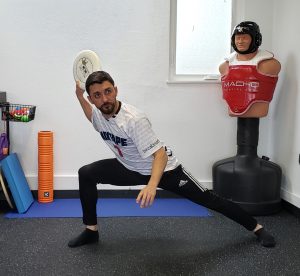
This is where the importance of mobility and mobilization comes in, deus ex machina style.
How Mobility Helps
When it comes to modern human movement, “an ounce of prevention is worth a pound of cure.” Mobility equipment and regimens can be the best prevention we have in our arsenal. In a future blog, I’ll be discussing the essential tools that I use to help my clients and patients attain the honorary rank of “mobility masters”.
How Mobility Hurts
Too much mobility, or hypermobility, can also be a problem. A few classic examples would be a chronically dislocating shoulder or a missing ACL – these conditions are instances of a lack of stability in and around a joint, leading to an abundance of mobility, leading to a higher chance of injury when loading those areas.
Clients with these issues typically require rehab to restore motor control and muscular strength as a substitute for those missing ligaments or torn tissues. Even overstretching can lead to similar outcomes and limit functional capacity in our clients.
How to Identify the Right Balance
Understanding and identifying ROM issues in your clients, then implementing stretches or utilizing mobility tools are the first steps to finding balance.
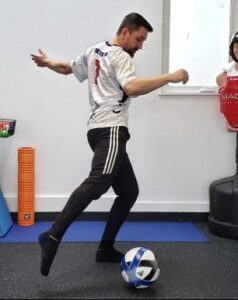

The client should be able to do an assigned movement with proper form before adding weight – this demonstrates ideal ROM for that exercise. Identifying proper form first is the easiest way to be confident that your client’s ROM isn’t too hot or too cold, but juuuust right.
You might encounter some more obvious postural distortions and muscle imbalances that require a heavier tackle, especially with joints like the shoulder with many joint actions creating more opportunity for poor mobility to develop. Learning how to assess those specific shoulder ROMs can be done quite thoroughly and provide even more information to improve mobility.
You can check out the following short video and see how one can improve joint mobility quickly with a few mobilization approaches:
For those who want to get everything they possibly can out of every joint, there are entire programs dedicated to such an endeavor such as Kinstretch, where one basically mobility-trains each joint for a few weeks.
And when in doubt, you can pretty much count on the ankles and the scapulae to have some kind of restriction in almost everyone. If you haven’t already checked out the Three Essential Exercises to Improve Client Mobility, now might be the time! These are great movements to address the most common mobility issues.
When they are all pliable/flexible/mobilized, use your professional training instincts to build strength and stability throughout those mobilized systems. Easy as that!