
For a client who attends Pilates four days per week, the suggestion that she may need additional resistance training can understandably seem perplexing. After all, she exercises consistently, finds the sessions challenging, and has already made physical activity a meaningful part of her routine. Nevertheless, in looking more closely at how that routine develops muscular strength, the relationship between attendance and the intended outcome may prove less straightforward.
For personal trainers working with women in midlife, this distinction provides a useful starting point. Specifically, we can acknowledge the value of an established exercise habit whilst examining whether the demands imposed by that habit match the physical qualities the client hopes to develop. The purpose of this conversation is to identify where her existing efforts serve those objectives and where a more deliberate training approach may be needed.
NFPT’s discussion of training through transition provides broader context for supporting clients during menopause. Building upon that conversation, this article examines how trainers can assess the resistance stimulus, interpret the relevant evidence, and make progression a practical part of the client’s program.
Start With the Adaptation
In looking at the adaptations a client hopes to achieve, some basic definitions become particularly useful. Strength describes the ability to produce force, hypertrophy describes an increase in muscle size, and muscular endurance concerns the ability to sustain or repeat muscular work. Although these qualities overlap, improvement in one should not automatically be taken as evidence of equivalent improvement in the others.
To illustrate, a client may become increasingly proficient at completing a lengthy sequence of controlled movements. This represents a meaningful improvement in that task, yet it does not tell us how much more force she can produce during a heavier squat or press. In other words, the outcome we measure needs to reflect the quality we claim to be developing.
With respect to these distinctions, the 2026 ACSM position stand found that heavier loads tended to favor strength, whilst higher training volume favored hypertrophy. Equipment type did not consistently determine outcomes (Currier et al., 2026). Consequently, descriptions such as “uses weights” or “does Pilates” tell us relatively little until we also consider the exercises, resistance, effort, and progression involved.
This becomes especially relevant when the name of a class is used to imply benefits ranging from muscle development to bone protection. Each of these claims requires appropriate evidence. A challenging abdominal sequence, for example, may serve a particular purpose whilst leaving the demands placed upon the legs, back, chest, and shoulders insufficiently addressed.
Give Pilates Its Due
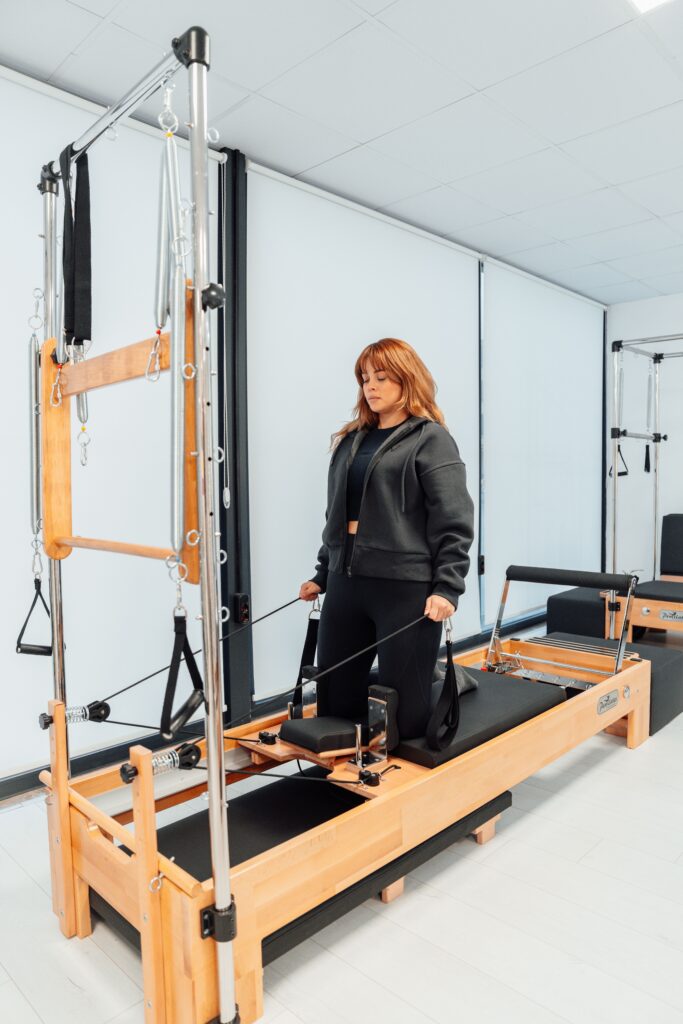
In examining Pilates itself, it is important to recognize that body weight and springs can provide meaningful resistance. An unfamiliar movement may also prove considerably challenging, particularly for someone with limited experience of that task. Nevertheless, acknowledging this challenge still leaves the trainer with an important question: how does the demand relate to the client’s stated goals, and how will it develop as her ability improves?
In an 18-week randomized trial involving women aged 60–80, Carrasco-Poyatos and colleagues (2019) compared Pilates, resistance training, and a control condition. Pilates improved hip isometric extension strength relative to control. Most other between-group strength and balance comparisons were not statistically significant.
In interpreting these findings, the distinction between an observed benefit and a broader claim of equivalence becomes particularly important. The trial did not establish that the methods were equivalent, nor did it demonstrate superior whole-body muscle growth with either approach. Given that the participants were older women and the assessments concerned specific strength and balance outcomes, extrapolating these results to every midlife client or Pilates class would exceed what the study can tell us.
From a programming standpoint, an activity can therefore provide worthwhile benefits whilst leaving other needs unmet. The trainer’s task is to examine that potential gap through the client’s goals and actual training demands, rather than assume that consistency alone has already filled it.
Audit the Demand
In looking to conduct this assessment, begin with the muscle groups receiving a substantial challenge. Review the actual exercises, their range of motion, and the assistance or resistance involved. For instance, a spring may increase resistance during one movement whilst assisting another, implying that its color or setting cannot, by itself, describe the muscular demand across the session.
Next, consider what ultimately limits the set. Does the intended muscle approach a meaningful level of fatigue whilst technique remains controlled, or does the task end because of balance, discomfort, choreography, or the class moving on? These observations help clarify what the exercise demands, although concerning symptoms still require appropriate evaluation rather than an assumption that they simply reflect training effort.
Repetitions in reserve, or RIR, provides one practical way to discuss this effort. Specifically, an estimate of three RIR means that the client believes she could perform approximately three additional, technically sound repetitions. Given that beginners need practice making this judgment, the estimate should be considered alongside movement quality and the client’s response, with appropriate recognition of its limitations.
Finally, examine how the demand has changed over several weeks. Completing more controlled repetitions with the same resistance may represent progress, as may increasing resistance whilst maintaining comparable technique and repetitions. By comparison, making a task less stable may increase its difficulty without necessarily increasing the force-producing demand upon the intended muscle.
To illustrate this distinction further, consider the difference between recording visits to a bank and examining what was actually deposited. Four visits establish a pattern of attendance; the contents of the account tell us what those visits contributed. Likewise, a training record should help explain what the client’s consistent efforts are contributing toward each goal.
Progress the Challenge
Progressive overload can best be understood as adjusting the training demand as the client’s capacity improves. In practice, this requires the trainer to respond to demonstrated performance, including the quality of the movement and the effort involved. Increasing resistance on a predetermined date, regardless of those observations, would miss the purpose of the progression.
A recent eight-week study in untrained young women compared progressive and unchanged loading during unilateral elbow-extension training. Both conditions increased muscle thickness, but progressive loading produced greater gains (Kassiano et al., 2026). This supports progression whilst also reminding us that early improvement can occur without continual load increases. It does not establish an exact prescription for postmenopausal women or whole-body training.
To this end, a trainer might select an appropriate machine or dumbbell exercise and establish a manageable repetition range. Once the client repeatedly reaches the upper end with the intended effort and technique, a small resistance increase may be appropriate. Repetitions may then move toward the lower end as she becomes accustomed to the additional demand.
The value of this example lies in the relationship between recorded performance and the subsequent decision. Equipment increments, changes in symptoms, and the need for further technical practice may each influence that decision. Consequently, exercises need not progress at identical rates for the overall program to demonstrate a clear direction.
Build a Decision the Client Can Use
For a client whose Pilates routine leaves a gap in whole-body strength progression, structured resistance training provides a practical means of addressing that need. Machines and free weights make external loading relatively straightforward to select, record, and adjust. Appropriately challenging bands and body-weight exercises can also contribute, provided their demands remain suitable for the intended adaptation.
The NSCA’s position statement for older adults emphasizes individualized instruction and progression (Fragala et al., 2019). Whilst many midlife clients are younger than the population addressed by that statement, its emphasis provides a useful coaching principle: program decisions should reflect demonstrated capacity and relevant health circumstances. Age or sex alone cannot supply that information.
In applying this principle, review the client’s health history and follow appropriate screening and referral procedures. Known osteoporosis, new pain, or other clinical concerns may influence exercise selection and warrant coordination with a qualified clinician. Supporting a client during menopause remains distinct from diagnosing hormonal problems or prescribing their treatment.
NFPT’s guidance on working with seasoned fitness enthusiasts also reminds us to recognize the experience a regular exerciser brings to the conversation. A useful opening might be: “You already have a routine you value. Let’s look at where it supports your goals and where we can make strength development more deliberate.” This allows the assessment to build upon the client’s efforts.
Ultimately, the program should allow both trainer and client to explain what is being developed, how it is being monitored, and when an adjustment is appropriate. If greater strength and muscle development are among the client’s goals, those objectives deserve an identifiable place within her week. By connecting consistent participation to specific, progressive demands, we give her existing commitment a clearer direction.
References
Carrasco-Poyatos, M., Ramos-Campo, D. J., & Rubio-Arias, J. A. (2019). Pilates versus resistance training on trunk strength and balance adaptations in older women: A randomized controlled trial. PeerJ, 7, e7948. https://doi.org/10.7717/peerj.7948
Currier, B. S., D’Souza, A. C., Fiatarone Singh, M. A., Lowisz, C. V., Rawson, E. S., Schoenfeld, B. J., Smith-Ryan, A. E., Steen, J. P., Thomas, G. A., Triplett, N. T., Washington, T. A., Werner, T. J., & Phillips, S. M. (2026). American College of Sports Medicine position stand. Resistance training prescription for muscle function, hypertrophy, and physical performance in healthy adults: An overview of reviews. Medicine & Science in Sports & Exercise, 58(4), 851–872. https://doi.org/10.1249/MSS.0000000000003897
Fragala, M. S., Cadore, E. L., Dorgo, S., Izquierdo, M., Kraemer, W. J., Peterson, M. D., & Ryan, E. D. (2019). Resistance training for older adults: Position statement from the National Strength and Conditioning Association. Journal of Strength and Conditioning Research, 33(8), 2019–2052. https://doi.org/10.1519/JSC.0000000000003230
Kassiano, W., Santos-Melo, V., Manske, I., Lisboa, F., Miguel, A., Gomes, F., Prado, A., Stavinski, N., Costa, B., & Cyrino, E. S. (2026). Progressive overload affects the magnitude of muscle hypertrophy. Medicine & Science in Sports & Exercise, 58(7), 1556–1565. https://doi.org/10.1249/MSS.0000000000003968