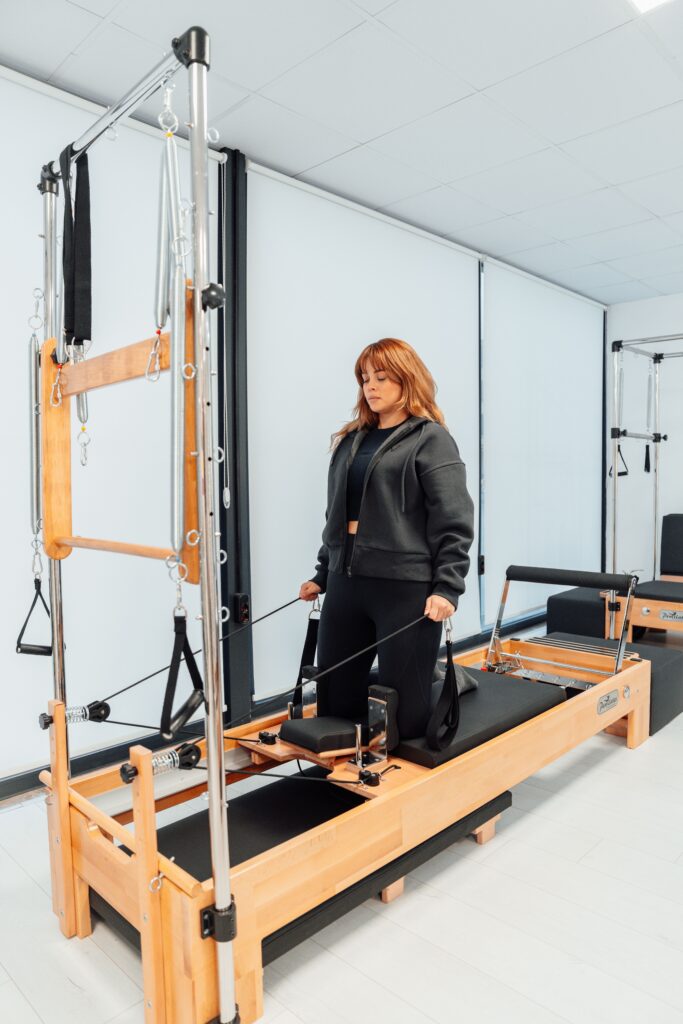
In looking to introduce resistance training to a woman in midlife who already enjoys Pilates, one of the first considerations is the routine she brings with her. Work, family responsibilities, established classes, and personal preferences already compete for space within her week. Consequently, even a well-intended recommendation to begin lifting may sound like a request to give up something she values.
For personal trainers, the opportunity is to build upon that existing commitment through a more complete program. Specifically, this means giving strength development a clear place within the week whilst considering how it interacts with the activities the client already performs. The quality of the plan depends, in part, upon how well these individual pieces work together.
In the first article of this series, we examined how to assess whether a routine provides a sufficient resistance stimulus. Building upon that discussion, the following framework turns to the practical considerations of scheduling, exercise selection, and progression. The aim is a program the client can understand, repeat, and develop over time.
Begin With the Week She Already Has
A practical starting point is to establish what the client’s week actually entails. Ask about her Pilates sessions, walking or other aerobic activity, previous lifting experience, and available time. In addition to these logistical considerations, explore what she enjoys and what she finds intimidating, since a technically sound program still needs to be workable within her circumstances.
NFPT’s guidance on working with seasoned fitness enthusiasts is particularly relevant when someone has attended classes for years. Whilst a new activity may require additional instruction, the client’s existing exercise experience still deserves recognition. Learning to use a chest-press machine, for example, represents a new skill within an already established commitment to being active.
With respect to the intended outcome, encourage the client to describe what improvement would mean to her. Increasing the weight she can lift, building muscle, or feeling more capable of carrying luggage may each provide useful direction. These objectives can then inform exercise selection and progress measures, without becoming promises that a particular exercise will resolve every physical limitation.
Health history and appropriate screening provide further context for these decisions. Ask about relevant symptoms, previous injuries, osteoporosis, and clinical advice that could affect training, coordinating with a qualified healthcare professional when indicated. The trainer’s role is to design and adjust exercise within scope; diagnosing menopause or managing hormone therapy requires the appropriate clinical expertise.
Give Each Session a Job
To illustrate how the activities might fit together, consider full-body resistance sessions on Monday and Thursday, with Pilates on Tuesday and Saturday. The remaining days can accommodate walking, other suitable aerobic activity, and rest, depending on the client’s circumstances. This provides an example to start a conversation, rather than a tested prescription for the best sequence for every woman.
In examining this arrangement, the separation between lifting sessions creates an opportunity to observe the client’s response. Nevertheless, Pilates should not automatically be classified as recovery work. A demanding class may contribute substantial fatigue, making its actual content relevant when deciding where another challenging session belongs.
The CDC’s adult activity guidance includes muscle-strengthening work on at least two days per week, alongside aerobic activity. In considering these broader recommendations, trainers should examine how lifting and Pilates sit within the client’s overall activity plan. Attending either type of session does not, by itself, establish that every component has been addressed.
A useful analogy is that of a teaching schedule in which different subjects contribute to a broader education. The subjects may complement one another whilst covering different material. Likewise, giving each session a defined purpose helps the client understand its contribution and allows the trainer to identify gaps or unnecessary duplication.
A Worked Example for the Weight Room
For a practical example, consider a hypothetical, screened client with no identified contraindication to the movements described below. She has two gym appointments available and is learning to use machines and dumbbells. The initial objective is to establish repeatable full-body training whilst creating a record that will support subsequent progression.
For Session A, the trainer selects a leg press, dumbbell Romanian deadlift, machine chest press, and seated cable row. For Session B, the trainer uses a supported split squat, seated leg curl, machine chest press, and lat pulldown. Each session also includes a suitable trunk exercise, such as a coached cable Pallof press. This provides lower-body work, pressing, pulling, and trunk training with a manageable exercise menu.
In applying this example, the exercise choices remain subject to the client’s needs and response. The Romanian deadlift requires coaching, and a suitable machine alternative may be preferable when learning demands or tolerance interfere. Similarly, a pressing movement should be adjusted or replaced when unsuitable, so that the client can perform the intended work effectively.
Following a brief general warm-up and exercise-specific practice, begin with one working set per exercise during initial familiarization. Progress toward two working sets as technique and tolerance permit. An illustrative target is 8–12 controlled repetitions, leaving approximately 2–3 technically sound repetitions in reserve once the client can meaningfully estimate effort.
Allow roughly two minutes between working sets, extending rest when needed to preserve technique and the intended effort. With instruction and transitions included, the appointment may take around 40–50 minutes. Maintaining the quality of the work should guide the session’s pace, even when the client could move more quickly between exercises.
This sample represents a coaching application, rather than an exact trial protocol or a universal hypertrophy prescription. The 2026 ACSM position stand supports progressive resistance training whilst demonstrating that outcomes depend upon the variables employed and the goal being pursued (Currier et al., 2026). Its findings should therefore inform the program without being interpreted as a requirement for every beginner to start with heavy maximal-strength loading.
Make Progression Visible
In looking to evaluate the program, record the exercise, load, repetitions, sets, and estimated repetitions in reserve, alongside meaningful technique or symptom observations. These measures provide the context necessary to interpret performance. Specifically, the record should help explain why a subsequent adjustment is appropriate and what the trainer expects it to accomplish.
To illustrate, suppose the client completes two sets of 12 on the seated row at the intended effort, with controlled technique, across two exposures. The trainer might then increase resistance by the smallest practical increment and allow repetitions to move toward the lower end of the range. If that increment prevents the intended performance, the next decision should reflect this response.
With respect to equipment, a spring change in Pilates and a stack change on a machine both need to be interpreted within the exercise being performed. Neither provides a standardized measure of whole-body training stress. The relevant consideration is how the adjustment changes that task in relation to the client’s goal.
Review results without promising a particular rate of muscle gain. In a study of women aged 40–60, Isenmann and colleagues (2023) observed strength improvements following a ten-week free-weight intervention; body-composition responses differed by menopausal group. Despite its title referring to 20 weeks, the study included a ten-week control phase followed by ten weeks of training.
In interpreting these findings, it is useful to distinguish improvements in strength performance from expectations about body composition. A client may demonstrate worthwhile progress whilst visible changes occur differently from what she anticipated. Furthermore, this study did not examine a combined Pilates-and-lifting schedule, so it cannot establish the ideal arrangement for that purpose.
Coach the Whole Person
Before each session, briefly review how the client responded to the previous one, whether symptoms or activity have changed, and whether the planned load remains appropriate. This creates an opportunity to place today’s performance in context. Persistent or concerning symptoms require an appropriate response and, when indicated, referral rather than continued encouragement to push through.
If a demanding Pilates class repeatedly compromises the following day’s lifting performance, consider moving the class, reducing overlapping work, or adjusting the strength session. Where practical, change one meaningful variable at a time so that the response can be interpreted. The objective is to improve how the week functions, with additional sessions considered only when they serve a clear purpose.
The NSCA’s older-adult position statement emphasizes individualized progression and instruction (Fragala et al., 2019). Although many midlife clients are younger than its target population, this emphasis remains useful when considering how a program should develop. Demonstrated ability provides a more meaningful basis for selecting the next load than an age bracket alone.
NFPT’s discussion of training through transition provides additional context for considering clients’ experiences during menopause. In applying that perspective, listen to the individual’s concerns whilst continuing to distinguish exercise decisions from clinical treatment. The client’s experience should inform the conversation without inviting conclusions beyond the trainer’s scope.
To this end, a complete program gives valued activities and progressive strength training a clear relationship to the client’s goals. By reviewing the demands of the week, teaching the necessary skills, and making adjustments from recorded performance, the trainer can help that relationship develop. The client should leave with an understanding of what today’s session contributes and how it connects to the work that follows.
References
Centers for Disease Control and Prevention. (n.d.). Adult activity: An overview. https://www.cdc.gov/physical-activity-basics/guidelines/adults.html
Currier, B. S., D’Souza, A. C., Fiatarone Singh, M. A., Lowisz, C. V., Rawson, E. S., Schoenfeld, B. J., Smith-Ryan, A. E., Steen, J. P., Thomas, G. A., Triplett, N. T., Washington, T. A., Werner, T. J., & Phillips, S. M. (2026). American College of Sports Medicine position stand. Resistance training prescription for muscle function, hypertrophy, and physical performance in healthy adults: An overview of reviews. Medicine & Science in Sports & Exercise, 58(4), 851–872. https://doi.org/10.1249/MSS.0000000000003897
Fragala, M. S., Cadore, E. L., Dorgo, S., Izquierdo, M., Kraemer, W. J., Peterson, M. D., & Ryan, E. D. (2019). Resistance training for older adults: Position statement from the National Strength and Conditioning Association. Journal of Strength and Conditioning Research, 33(8), 2019–2052. https://doi.org/10.1519/JSC.0000000000003230
Isenmann, E., Kaluza, D., Havers, T., Elbeshausen, A., Geisler, S., Hofmann, K., Flenker, U., Diel, P., & Gavanda, S. (2023). Resistance training alters body composition in middle-aged women depending on menopause—A 20-week control trial. BMC Women’s Health, 23, Article 526. https://doi.org/10.1186/s12905-023-02671-y