

Improving thoracic mobility and lengthening the latissimus dorsi are essential steps to laying a strength foundation for a pull-up progression routine. Before incorporating the following exercises, you should have determined what your client’s limitations are from the last blog on how to assess shoulder mobility restrictions.
The following exercises are designed to address mobility limitations in the lats and thoracic spine.
Release and Lengthen Lats
Release Lats
For the client with shortened lats, you’ll want to release the lats first and then stretch to lengthen them.
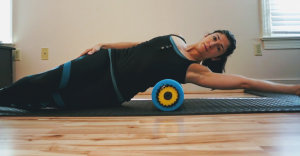
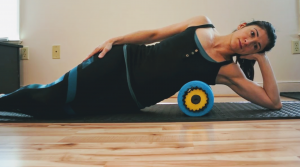
- Lie on your side on the floor with a foam roller placed perpendicular to your body and directly below the shoulder blade.
- Arm should be straight and shoulder flexed to end range of motion.
- If neck tires in this position, the elbow can be flexed so the hand can support the head. But try to keep shoulder area relaxed.
- Explore the soft tissue just below the inferior border of the scapula looking for a tender spot or trigger point.
- Hold for 30 seconds or until a release is felt.
- Move foam to another tender spot and repeat.

Statically Stretch Lats
- Lie in child’s pose on the floor, arms outstretched overhead, and forehead to the ground.
- It may help to support head with a yoga block or rolled up towel.
- Walk arms to one side until a stretch is felt from pelvis to armpit while keeping hips anchored over legs.
- Drop opposite shoulder closer to floor while rolling upwards towards ceiling.
- Hold stretch for 30 seconds and repeat on opposite side.
Dynamically Stretch Lats
The following stretch is good to incorporate after lats start to loosen up and also into a warm-up for a strength routine going forward.
- Stand with one leg crossed slightly behind the other.
- Pull navel to spine and engage abs.
- Strive to flatten low back during the reach to maximze lat stretch.
- Take arm of back leg and reach over head while sidebending slightly to opposite side.
- Move methodically and hold end position for two seconds before returning to start.
- Repeat 10 times and switch sides.
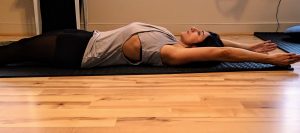
Remember: Optimal lat length is exhibited when lying flat on the ground and flexing the arms to 180 degrees so that they lay flat on the ground by the ears:
Improve Thoracic Mobility
If the client is unable to extend the thoracic spine at least 20 degrees, then start with foam roll mobilizations. These can be performed daily until an adequate adaptation is observed.
Thoracic Spine Self-Mobilizations
- Place the foam roller between the upper shoulder blades with arms over the head and butt on the floor.
- Support the head and neck with hands if necessary. You may even hold a ball under your chin to prevent cervical spine extension.
- Allow thoracic spine to extend over foam roll as far as range of motion will comfortably allow and hold for 3 seconds.
- Return to start position by engaging abdominals and flexing spine.
- Perform this motion 5 times; roll down another inch.
- Repeat the process and roll down towards next segment, stopping just below shoulder blades.
- This process can be repeated up to twice more for 3 sets, though benefit is gained from just one set.
Thoracic Spine Extensions
Total spine back extensions are driven largely by the lumbar spine, preventing full participation of the thoracic spinal extensors. Locking the lumbar spine into flexion allows for more targeted extension, albeit smaller, to occur through the T-spine.
- Sit on floor with knees together and torso folded forward so abdomen is resting in lap (like child’s pose).
- With fingers at temples and chin tucked (hold a ball under the chin if necessary) lift elbows and extend thoracic spine without lifting abdomen from legs or extending cervical spin.
- Hold at top for 3 – 5 seconds. Perform two sets of 12-15.
- If kneeling on the ground in the start position is contra-indicated, this movement can be replicated by sitting in a chair.
“Open Book” Rotation Drill
Allowing the spine to rotate through a full range of motion is as much a component of thoracic mobility as is extension.
- Lie on side on floor. Top knee should be bent, level with hip and supported by a foam roll. Bottom leg is straight.
- Bottom arm is supporting head. Top arm is straight in front of chest, palm to floor.
- Slowly bring top arm towards floor behind you while twisting torso, and opening chest.
- Hold end position for 3-5 seconds and return to start.
- Repeat on this side 5 to 10 times, aiming for greater ROM with each rep.
- Repeat on opposite side.
Program the above exercises where appropriate for at least two weeks and note if progress is made. Once mobility has improved so that initial assessments are passed, the client can move on to improving any other restrictions in shoulder mobility, such as scapular rotation dysfunction and an imbalance in internal and external rotation at the glenohumeral joint.