
Compression therapy, an ages-old medical technique involving specially designed garments that apply pressure to different parts of the body, serves a wide variety of purposes. Its primary goal, that of venous return, can improve blood circulation, relieve a range of health issues, facilitate post-surgical healing, and promote overall well-being. Athletes in particular can benefit from recovery sleeves and other compression garments. This article explores the uses and functions of compression therapy, including how to ensure proper fit and care for the products.
A Brief History
The first mention of compression therapy as a medical treatment surfaced around 450-350 BC, appearing in the Corpus Hippocraticum. This collection of 60 medical texts, attributed to the physician Hippocrates of Cos, has had its share of supporters and detractors for centuries. The original belief that pressure exerted could counteract the effects of gravity and benefit wound healing in the lower limbs still holds merit today. Compression therapy applied with bandages evolved as a conservative treatment for varicose veins in 1440. Over the last 50 years, physicians have employed compression therapy for burn care as well as minimizing the formation of hypertrophic scars.
How Does Compression Therapy Enhance Athletic Recovery?
Applying targeted pressure through compression garments boosts blood circulation and reduces inflammation, both of which will expedite healing. Since the bloodstream carries and delivers oxygen, improved circulation supports healing and recovery. Once the oxygen in the red blood cells is used up, the blood returns to the heart to be re-oxygenated. Compression products apply light pressure to the veins to encourage blood flow and force deoxygenated blood back up to the heart.
Compression garments can likewise serve as an essential tool for individuals recovering from surgery or suffering from certain medical conditions. By improving blood flow, these garments reduce swelling and prevent blood clots.
Compression therapy can help individuals facing a range of challenges, including the following ~
- Individuals with chronic pain
- Post-surgery patients
- Frequent travelers
- Pregnant women
- Individuals with poor circulation
- Professionals with sedentary jobs
Gravity Compounds Lower Limb Healing
Treating wounds and/or swelling in the lower limbs can create its own set of challenges. Due to the forces of gravity, legs present with a very different set of concerns from those of upper limb wounds. Legs require support to heal, especially in the presence of underlying venous disease/hypertension, swelling, excess weight, or immobility.
If a lower-limb wound fails to heal in a timely manner, in the absence of venous complications, compression therapy may offer considerable help. It can reduce swelling, improve blood flow, and foster the healing and/or prevention of ulcers on the skin at the wound site.
Complexity of Design
Traditional medical compression therapy often begins with stockings or bandages, which provide gradual compression from the distal to the proximal regions of the affected limb(s). Two main principles comprise the therapy. The first one aims to create an enclosed system that allows for evenly distributed internal pressure in the limb. This principle involves the application of Pascal’s Law -given a fluid in a totally enclosed system, a change in pressure at one point in the fluid will be transmitted to all points as well as the enclosing walls. This effect reduces venous diameter, forcing venous blood to return to the heart. The second principle involves the application of Laplace’s Law — tension in a vessel or structure wall aligns directly with its pressure and radius. Adhering to this law helps create a varied interface pressure based on limb shape and the tension of the compression device.
Three important steps go into the development of a design system for customized compression garments ~
- Acquire exact measurements of body shape/size.
- Find a mathematical model to determine the size and properties of compression garment and the pressure exerted.
- Develop a computerized system to design the compression garment based on the above mathematical model.
Upon completing these steps, manufacturers must then consider three additional essential design components: fit, slip, and fabric stretch. The garment fit, determined by the ratio of garment size to body size and the nature of the garment design, provides for skin strain. For compression garments, the garment size reflects a smaller body size, with the reduced proportion serving as the reduction factor. The garment slip refers to the coefficient of friction between skin and fabric, and between layers of the garment. Since compression garments typically fit with a certain amount of “pre-tension”, the fabric’s stretch determines the pressure exerted on the body parts. If a garment has high friction and stretching resistance, the body will perceive a definite amount of pressure, which, in some cases, may result in initial discomfort.
Since compression garments are designed for continuous wear for at least several hours, and sometimes during intense exercise, most individuals can expect an adjustment period until the initial discomfort subsides. In addition, the typical design aims to reflect features such as human anatomy, ergonomics, material choices, and cost. Garments made specifically for medical conditions also take antibacterial properties and moisture transmission of materials into account. An improperly fitted compression garment could affect the user’s energy, work efficiency, and health. Insufficient pressure limits its efficacy, while excess pressure can cause numbness to the body part or even breathing difficulty.
Combatting Exercise-Induced Muscle Fatigue
The concept of exercise-induced muscle fatigue encompasses the temporary and reversible decrease in muscle contraction force following sustained muscular activity. Often this situation depends upon a number of factors:
- Age
- Gender
- Mode of exercise
- Health status
- Duration of exercise
As we would imagine, such fatigue often takes away from an athlete’s ability to perform optimally, as it taxes both muscle power and strength.
One research study sought to test the effects of compression garments on mitigating the decline in muscle strength and power resulting from exercise-induced muscle fatigue. Data revealed that compression garments significantly reduce the decline in muscle strength. While both trained and untrained individuals can benefit from compression garments, their effectiveness seems more pronounced in trained athletes than in untrained individuals.
In addition, research published in the Journal of Strength and Conditioning Research demonstrated that wearing compression garments after exercise can reduce perceived muscle soreness and accelerate the recovery of muscle function.
Choosing Between Sleeves and Socks
While both compression socks and recovery sleeves serve similar purposes, elite athletes find they do vary in their individual abilities.
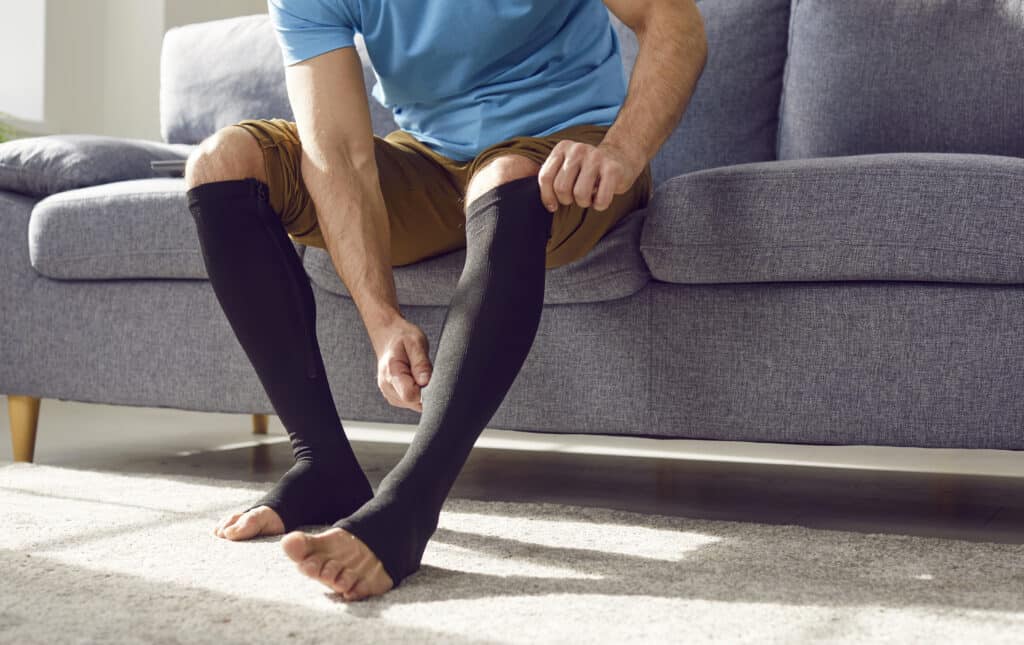
Recovery socks/stockings, often utilized by serious runners, deliver a graduated level of compression, with firmer pressure starting at the ankles and gradually lessening towards the knee. Recovery compression socks offer support in a number of ways:
- Faster Lactate Clearance: Improved blood flow helps remove metabolic waste products that could contribute to muscle soreness/stiffness
- Reduced Swelling: Consistent pressure limits the accumulation of fluid in the lower legs following intense/prolonged exercise
- Decreased Muscle Oscillation: Supporting tired muscles lessens the micro-movements that can prolong soreness
- Enhanced Venous Return: Graduated pressure pushes blood toward the heart, improving circulation at a point in time when legs feel most fatigued
Much like the socks, compression sleeves also offer a compression gradient that encourages blood flow back to the heart. These sleeves prove useful in the following scenarios:
- Post-Exercise Recovery: Calf sleeves slip on easily after a run, without needing to wear full socks
- Warm Weather: Sleeves provide compression benefits while keeping the feet cool and unrestricted
- Targeted Calf Recovery: When engaging in activities in which the calves bear the brunt of the effort, sleeves deliver focused, targeted compression where needed
- Pairing with Recovery Sandals: Combining calf sleeves with recovery sandals offers complete post-run support
Timing the Use of Compression Garments for Recovery
As most elite athletes know, timing matters when it comes to compression and recovery. The following list may help personal trainers make suggestions to their clients, in an effort to maximize the benefit received from their garments.
- Immediately After a Run: The first 30-60 minutes after exercise represent a critical recovery window. Putting on compression socks right promptly following cooldown. takes advantage of this period, when the body responds best to recovery interventions
- Extended Wear (2-4 Hours): For optimal benefits, some athletes continue wearing post-run recovery socks for several hours after exercise.
- After Long Runs or Hard Workouts: Longer efforts and high-intensity sessions create more muscle damage and inflammation. These workouts warrant extended compression wear, potentially throughout the remainder of the day.
- During Travel: If a competitive event takes place out of town, requiring the athlete to travel, compression becomes even more valuable, especially when traveling by air. The combination of muscle fatigue and prolonged sitting makes post-run recovery compression socks extremely valuable.
Proper Care for Prolonged Use
While compression garments can help a variety of athletic/health situations, one must take certain steps to ensure their continued effectiveness over time. Below, we offer some helpful tips for properly caring for compression garments to prolong their longevity.
Wash Regularly
Compression garments need regular cleaning to maintain their effectiveness. Sweat, dirt, and body oils build up on the fabric, leading to odor and bacterial growth. Washing the garment after every use will prevent this buildup and keep it fresh and clean. However, manufacturers recommend avoiding fabric softeners or bleach, as these can damage the compression fibers. Instead, choose a gentle detergent and cold water.
Air Dry
When drying compression garments, air-drying works best. High heat can damage the compression fibers, causing them to lose their elasticity and effectiveness. Hang them to dry or lay them flat on a towel. Avoid wringing them out, as this can also damage the fibers. If in a hurry and must use a dryer, start with the lowest heat setting possible.
Proper Storage
Always store compression garments in a cool, dry place. Avoid direct sunlight exposure, as UV rays can damage the fibers. Do not fold or crease them, as this can damage the compression properties; roll them neatly and store them in a drawer or on a hanger.
Replace Regularly
Compression garments lose their effectiveness over time, so frequent use will require regular replacement. Depending on the brand and usage, most compression garments last anywhere from 3-6 months. If the garment fails to provide the compression it once did, or if it gets damaged or stretched out, replace it immediately. Kim Sacia, Regional Manager of Mayo Clinic Stores in Wisconsin, says, “The elastic fibers used in compression break down through extended wear and washes and should be replaced regularly to ensure you are receiving proper compression strength and therapy.”
Watch the Clock
While compression garments are most helpful for improving blood flow and reducing swelling, one must keep in mind that they should not be worn for too long. Extended periods of use can cause skin irritation and damage, and, in rare cases, may even lead to blood clots. Follow the instructions provided by a physician or the product’s manufacturer regarding how long to wear the garment each day.
Remove Overnight
Removing compression garments at night allows the skin to breathe and recover. If a medical professional has advised overnight wear, carefully follow the instructions provided by the product’s manufacturer or as directed by the physician.
Research continues to support the role of compression therapy in reducing inflammation around a wound, general swelling, and post-workout recovery. Compression can directly reduce pain, minimize skin color changes, and support the calf/foot muscles in working more effectively. Using compression garments in tandem with ankle and calf exercises can make the compression therapy even more effective. While these garments may not function for everyone, they generally offer relief and do not cost a fortune. Try them out and see for yourself!
References
macombpainmanagement.com/do-compression-sleeves-actually-work/#:~:text=Compression%20can%20help%20many%20forms,where%20you’re%20experiencing%20pain.
evolvept.com/5-benefits-of-compression-therapy-who-should-seek-compression-therapy-treatment/#:~:text=Compression%20therapy%20relieves%20chronic%20pain,individuals%20dealing%20with%20persistent%20pain.
store.mayoclinic.com/education/caring-for-compression-garments/#:~:text=Don’t%20wear%20them%20for,even%20lead%20to%20blood%20clots.
legsmatter.org/information-and-support/treatment-options/compression-therapy/#:~:text=Compression%20therapy%20is%20very%20effective,or%20preventing%20sores%20or%20ulcers.
ceprunning.com/blogs/news/wearing-compression-socks-sleeves-for-post-run-recovery#:~:text=Compression%20benefits%20recovery%20after%20any,routine%20regardless%20of%20workout%20intensity.
pubmed.ncbi.nlm.nih.gov/24596693/
pmc.ncbi.nlm.nih.gov/articles/PMC6404358/
nike.com/ca/a/how-to-use-compression-sleeve
pmc.ncbi.nlm.nih.gov/articles/PMC11944185/#:~:text=Wearing%20compression%20garments%20during%20or,enhancing%20muscle%20recovery%20%5B4%5D.