
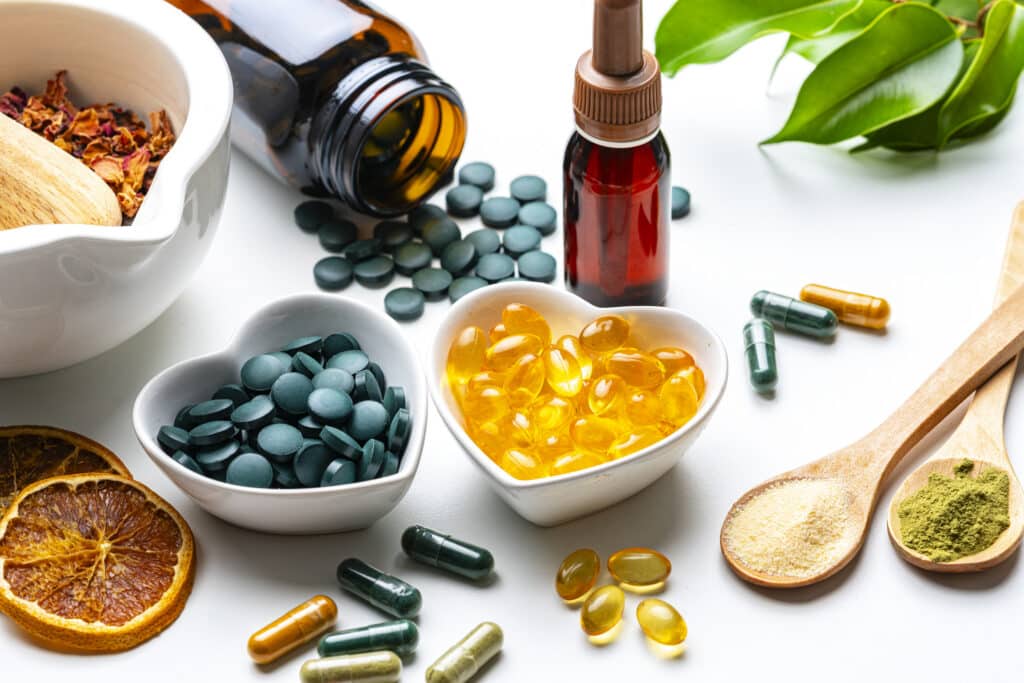
Grocery stores and health food markets sell supplements claiming to do everything from preventing a cold to improving mood, reducing stress, and amplifying athletic performance. These potential benefits have garnered them a great deal of attention over the past 5-10 years. However, taking certain supplements together can cause more negative interactions than benefits. This article explores how some supplements may counteract, overexpress, or hinder the absorption of others, or lead to undesirable health effects when consumed simultaneously. This article also addresses the potential effects of combining over-the-counter supplements with prescription medications.
Are We Enhancing or Harming Our Health?
The estimated worldwide sales of herbal and dietary supplements reached $220 billion in U.S. currency, a decades-long trend which experts predict will continue to rise. These items, purchased without a prescription, also do not face strict FDA scrutiny. As such, consumers may fail to realize that while a particular supplement could in fact boost their well-being, another might unwittingly interfere. Here we highlight common minerals often taken together, and what may potentially go awry inside the body:
- Zinc/Calcium: These 2 essential minerals compete for absorption in the digestive system; taking them together can limit the effectiveness of each. Registered Dietitian Alyssa Simpson recommends consuming zinc and calcium supplements at least 2 hours apart.
- Zinc/Iron: When taken together, iron has the potential to reduce the body’s capacity for absorbing zinc. Supplements containing 25 mg or more of iron pose the highest risk to zinc levels.
- Calcium/Non-Heme Iron: According to Registered Dietitian Carla Hernandez, calcium inhibits the absorption specifically of non-heme iron, the type found in abundance in plant-based sources, by competing for absorption sites within the intestinal tract.
- Zinc/Magnesium: High doses of these taken together likewise compete for absorption in the intestines. Health care providers typically suggest spacing these out by at least 2 hours.
Treating Depression: Herbal Supplement versus Pharmaceuticals
Researchers continue to debate the efficacy of St. John’s Wort in managing depression. Years ago, fans of herbal remedies suggested that it might ease depression symptoms by helping to elevate the body’s serotonin levels (the ‘feel-good” chemical). If this does in fact occur, taking the supplements in conjunction with prescription anti-depressant medications could potentially lead to a life-threatening increase in serum serotonin levels.
These same risks exist when taking St. John’s Wort along with serotonin-boosting supplements. “Combining St. John’s Wort with serotonin-boosting supplements like 5-HTP or SAMe can elevate serotonin levels too much, potentially leading to symptoms like restlessness and confusion,” says Simpson. “Stick to one serotonin-supporting supplement at a time,” she says.
Warfarin Warning
As our population ages, more and more doctors find themselves prescribing warfarin, a blood-thinning medication, as a means of reducing blood clots and stroke risk. While highly effective, these supplements pose risks when taken alongside certain otherwise helpful supplements.
For example, both ginkgo biloba and high-dose fish oil tend to thin the blood. When taken together, they can increase the risk of excessive bleeding. If a person also happens to take a daily dose of warfarin, the results could prove deadly. Other potentially blood-thinning supplements should likewise not be taken together with warfarin: aloe, garlic, ginger, turmeric, fenugreek, and ginseng. Again, taken individually, each of these can offer substantial benefits; the risk comes in not knowing how they react together or with prescription drugs.
As mentioned above, many individuals take warfarin to prevent blood clots from forming. Once in the body, the drug accomplishes this by blocking vitamin K, a nutrient needed for normal clotting. Since many over-the-counter multivitamins contain small amounts of vitamin K, starting or abruptly stopping its use may interfere with warfarin’s effects. If one desires a multivitamin, experts say to take it consistently. Signs such as easy bruising, leg swelling, and/or unusual bleeding may signal a change in the body’s clotting ability, especially if the individual has recently changed vitamin K intake through multivitamins or supplements.
Another potential complication exists when one takes glucosamine and chondroitin concurrently with warfarin. The change in warfarin’s effect due to glucosamine and chondroitin manifests as an increase in the International Normalization Ratio (INR), thereby increasing the risk of bleeding. When considering the risk–benefit ratio, the minimal clinical benefits of glucosamine and chondroitin in managing osteoarthritis symptoms versus the potential for a moderately severe adverse interaction, physicians may wish to have patients avoid this combination.
Unique Concerns of the Older Athlete
In some competitive circles, such as bodybuilding, age-based categories exist. The Master’s Division usually refers to athletes over 40 or 50 years of age. As one might expect, these adults, considered the healthy specimens of their age group, exercise and eat well, including boosting their systems with various supplements.
However, as ages increase, even healthy athletes will sometimes succumb to conditions associated with normal physiological changes, and these often require prescription medications: elevated blood pressure, high cholesterol/triglyceride levels, cardiac abnormalities, to name a few. Therefore, the possibility of taking prescribed medications for a chronic condition along with prevalent use of dietary supplements, especially in the competitive sports arena, may expose older athletes to adverse effects due to drug-nutrient interactions.
Recent evidence indicates that master ’s-level athletes often report increased intake of protein supplements, creatine, nitrates, and other beneficial supplements for the health of the ageing individual. In some cases, health care providers may even suggest these. They face an understandably higher level of concern for maintaining their health vis-à-vis the increased risk of chronic conditions with age, but this also raises the possibility of concurrent use of prescribed medications and supplements that may result in adverse side effects. Research data culled from the 2017 Australian Masters Games (AMG) and the 2018 Pan Pacific Masters Games (PPMG) indicate that almost 50% of older athletes reported taking up to 16 dietary supplements, and again, almost 50% used two or more prescription medications to treat chronic conditions.
Understanding the Specifics of Drug Interaction Mechanics
An interaction between a prescribed medication and a particular ingredient in a supplement can occur due to alterations in pharmacokinetic mechanisms and/or pharmacodynamic properties when the two are taken concurrently. A pharmacokinetic interaction manifests itself as either enhanced or reduced absorption, distribution, metabolism, and excretion of the drug. A pharmacodynamic interaction refers to the alteration of a drug’s pharmacological effect and mechanism of action caused by the combination of two or more substances. The clinical side effects of these interactions will vary depending on whether the drug’s effects are reduced or heightened. Elevated levels of a drug’s activity can bring about unwanted side effects along with toxicity. Reductions in a drug’s activity can result in a sub-optimal therapeutic outcome. Furthermore, interactions between drugs and nutrients may result in a compromised nutritional status, such as a dangerous electrolyte imbalance, which in turn directly impacts kidney function.
The Creatine Conundrum
Many athletes at the elite or competitive level choose to include creatine in their protein shakes to enhance nutrient uptake and boost athletic performance. However, the old adage “If a little is good, a little more is even better” does not apply here. According to Lara Zakaria, an integrative pharmacist and nutritionist specializing in functional medicine and personalized nutrition, “Once muscle stores are saturated, the body simply excretes the excess. That’s why most studies use that range consistently and safely.” Combining even 3-5 grams of creatine a day along with a protein shake could potentially lead to dehydration/kidney strain, and gastrointestinal issues.
Protein and Caffeine Problems
Research has shown that a morning cup of coffee can enhance one’s workout. However, combining an excess of caffeine with a dense protein shake can delay gastric emptying (food exiting the stomach), leading to acid reflux, nausea, and stomach cramps. Many common pre-workout supplements also contain caffeine, as do some brands of protein powders. These, coupled with a strong mug in the morning, can dangerously elevate both one’s heart rate and blood pressure. A careful reading of a product’s labels will provide the recommended daily dosage; then an individual can easily and safely space out its consumption separate from the protein shake.
Should Vitamins Be Consumed With or Without Food/Water?
Even if potential interactions do not cause problems, certain vitamin combinations do not mesh well. Water-soluble substances are not stored in the body; upon ingestion, they require water to be adequately absorbed. Many individuals routinely consume both vitamin D for bone health and vitamin B12 for energy. Vitamin D, a fat-soluble vitamin, is better absorbed when taken along with a meal. However, as a water-soluble vitamin, B12 is most effective when taken on an empty stomach or with a glass of water. The same logic exists when taking vitamin C (water-soluble) and vitamin D.
While clients typically solicit a person trainer’s input and opinion on the variety of sports-related supplements on the market, we can now see how the potential exists for dangerous side effects and/or toxicity levels. While we can’t recommend supplements, we need to stress the importance of consulting a personal health care provider or registered dietitian before taking any supplement; they have the client’s medical history, including any prescription medications currently administered daily. Most physicians today will ask their patients if they currently take any vitamins or other supplements. Having these on record can help prevent potentially uncomfortable and/or life-threatening occurrences.
References
https://bpspubs.onlinelibrary.wiley.com/doi/10.1111/bcp.14404
https://www.bubsnaturals.com/blogs/creatine-and-fitness/does-creatine-monohydrate-interact-with-medications?srsltid=AfmBOooKw_FvxjK5NaEFSnybbDBCDnoYBqc_UuOKyXemafK2BC3Z_rqe
https://www.health.com/supplements-not-to-mix-with-protein-powder-11846796
https://pmc.ncbi.nlm.nih.gov/articles/PMC9174319
https://www.fda.gov/consumers/consumer-updates/mixing-medications-and-dietary-supplements-can-endanger-your-health
https://www.eatingwell.com/medications-you-should-not-mix-with-your-multivitamin-11827634#:~:text=Blood%20thinners%2C%20thyroid%20medications%20and,may%20interact%20with%20a%20multivitamin.
https://www.eatingwell.com/supplements-you-should-never-take-together-11880455