

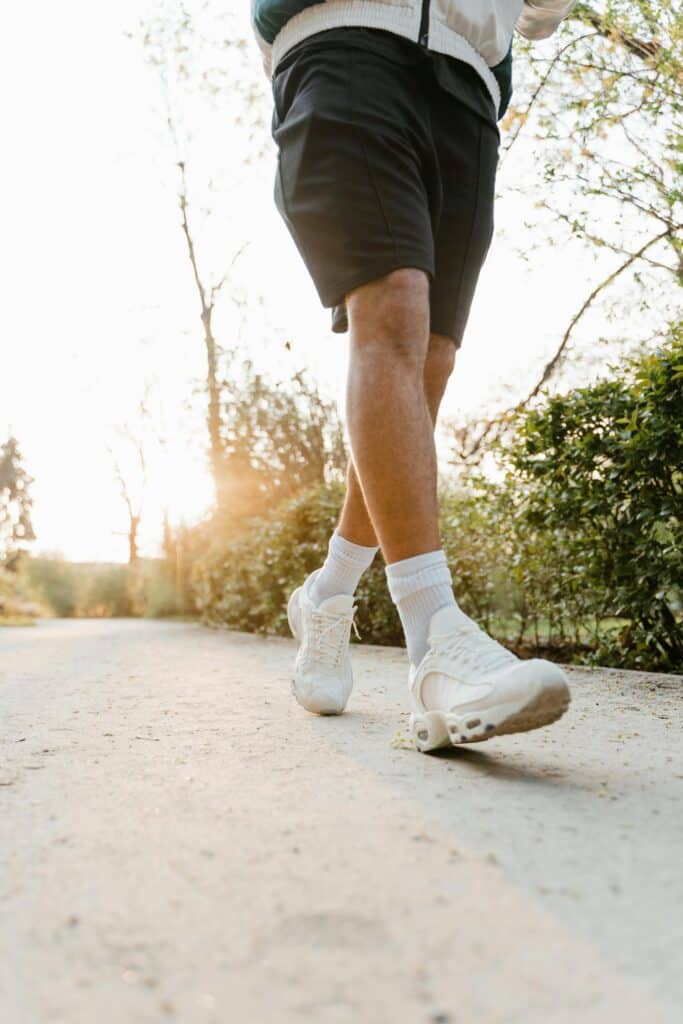
Many of today’s fitness-focused social media platforms are talking about a new trend called Japanese Walking. This exercise method boasts broad appeal due to its relative simplicity and high success rates. This article discusses the origins and specifics of this popular sport, and we will delve into the health benefits associated with regular participation.
Walking as Interval Training
Sometimes the simplest things in life end up offering great value. The Japanese Walking Method demonstrates exactly that, and has, since its inception almost 20 years ago.
Also known as Interval Walking Training, or IWT, this protocol originated in 2007 with research led by Dr. Hiroshi Nose and Dr. Shizue Maskuki, professors at the Shinshu University Graduate School of Medicine in Matsumoto, Japan. At its basic level, the Japanese Walking Method involves the following key aspects ~
- Structure: 5 cycles of 3-minute high-intensity walking (brisk pace) followed by a 3-minute low-intensity walking (easy pace), totaling 30 minutes
- Optimal Frequency: Most effective when done at least four days a week
- Benefits: Increased leg muscle strength, lower blood pressure, reduced stroke risk, and improvements in cardiovascular fitness
- Approachability: Its low-impact and joint-friendly nature make it suitable for older adults or those attempting to regaining fitness levels following any hiatus
The researchers categorize the high-intensity portion of the walk as 70% of one’s maximum effort, while slow, easy pacing moves at about 40%. Regular casual walking typically involves maintaining a steady pace for the duration of the walk, whereas with Japanese walking, one periodically switches speeds, which in turn provides a challenge to one’s muscles, heart, and lungs. “The changes in intensity push your heart and muscles, but the workout stays gentle on your hip and knee joints,” says orthopedic surgeon Shawn G. Anthony, MD, Associate Chief of Sports Medicine at Mount Sinai Health System in New York City.
Heart-Health Benefits Abound
As personal trainers, we recognize the role cardiovascular training plays in our clients’ overall wellness, particularly their heart health. Similar to what we observe during HIIT workouts, periods of elevated intensity raise one’s heart rate, increasing blood flow to the muscles, while periods of lower intensity allow one to comfortably recover their breathing pattern and lower their heart rate again. This on-off cycling of intensities improves cardiovascular fitness, thereby improving the body’s ability to consume oxygen effectively. If we consider a Japanese walking client engaging in 5 such interval cycles over just half an hour, we begin to understand how this program yields significant heart health benefits in a relatively short period of time.
A Joint Engagement
As we might expect, Japanese Walking programs demonstrate the ability to strengthen one’s joints when practiced consistently. The initial study that brought this form of exercise to the forefront of the fitness world followed 250 adults with an average age of 63 years; these subjects performed either high-intensity interval walking for at least 30 minutes or moderate-intensity walking at a steady pace for a total of 8,000 steps. Both groups walked at least 4 times each week over the course of five months.
In the high-intensity interval walking training group, isometric knee extension increased by 13% and isometric knee flexion by 17%, significantly greater increases than those observed in the moderate-intensity continuous walking training group. While the scientists came away from this project acknowledging that steady-state walking can provide health benefits, the interval protocol forced the subjects to work harder, yet not tax their joints as much.
Promising Blood Pressure Results
The hypotensive, or blood pressure-lowering, effects of high-intensity interval training seem well documented in the medical literature. However, few studies focus on an older-adult demographic. One unique study examined whether interval walking training might reduce blood pressure compared with a non-intervention group in community-dwelling older adults.
Both men and women participated in this study, with ages ranging from 70 to 80 years old. The Japanese Walking protocol set forth included fast-paced walking at 70-85% of peak aerobic capacity for 3 minutes, 5x/day, 4 days/week, over a 5-month duration. The light-intensity walking approximated 40% of peak aerobic capacity.
Interestingly, while the older adult females did not exhibit significantly lower blood pressure at the end of the program, the males with longer fast-walking times did experience notable decreases in blood pressure.
The Diabetes/Leg Strength Conundrum
For individuals living with Type 1 diabetes, Japanese Walking programs seem to improve glycemic control directly by enhancing glucose effectiveness, challenging previously held conventional views on the mechanisms underlying training-induced improvements in glycemic control. Generally, muscles work harder during the high-intensity intervals. Since blood sugar gets absorbed through the muscles, the Japanese Walking method should ideally help improve blood sugar control.
A common challenge facing researchers in this area rests on ensuring long-term adherence to such walking programs, particularly in populations with chronic diabetic comorbidities and/or overweight/obesity. One study examined the effects of high-intensity interval walking training versus moderate-intensity continuous walking training on muscle strength, walking ability, and health-related quality of life in people with diabetes and lower-extremity weakness.
The results indicated a significant increase in gait speed and overall quality of life among the group that performed interval walking. If more studies continue to reveal similar data, perhaps we will begin to see Japanese Walking Training suggested by physicians for their patients living with the challenges of Type 1 diabetes. One such physician, Dr. John Cleek, recognizes the value of such a program; he works at Novant Health General Surgery and Bariatrics in Mount Pleasant. He often suggests Japanese Walking to his patients. However, an “upper limit” does exist. Dr. Cleek found that if his patients walk at a brisk pace for 3 minutes, followed by 3 minutes at a faster pace, for a total of 50 minutes a week, their health improves. Over the past 50 minutes, they failed to observe any additional benefits of fast walking. Still, walking at one’s normal pace for any extended length of time will confer health benefits.
Greater Advantage, Smaller Time Commitment
As we have seen, participating in a Japanese Walking program can improve well-being in a variety of functional ways. Undoubtedly, efficiency ranks high among these benefits.
On average, the routine requires (or suggests, for starters) two hours each week. “We can compare this to the roughly 10 hours it takes to get the recommended 10,000 steps daily,” says Barbara Walker, PhD, an integrative health specialist and Professor of Psychiatry/Behavioral Neuroscience at the University of Cincinnati College of Medicine. This knowledge helps many individuals approach exercise with a positive attitude, rather than contemplating the seemingly endless hours of weightlifting and cardio at the gym.
Walking is a great way to perk up one’s mood while easing stress. For an even bigger benefit, experts suggest taking a walk outside. “The fresh air, natural scenery, and sunshine make it an even more rewarding experience,” Walker says. Similarly, Japanese walking requires attention to timing and pace. By dialing into the brain as well as the body’s energy systems, a walker will remain engaged and alleviate potential boredom. Dr. Walker reminds us that “the variety makes it easier to stay motivated.”
Scientists have found that Japanese walking can also confer mental benefits, especially among the elderly. In one study, adults aged 65 and older either participated in a high-intensity interval walking routine or a regular walking routine. Both groups improved their mood, sleep, and quality of life, but those who did interval walking had better endurance and overall flexibility.
Training Tips
Clients who wish to embark upon a Japanese Walking training program may come to personal trainers with many questions. Below we attempt to answer some of the more commonly asked questions, to help guide individuals on a safe starting path:
- Seek out and purchase walking or running shoes with good cushioning and a secure fit. Old and/or worn-out sneakers cannot provide adequate support and can lead to pain or injury.
- During the high-intensity intervals, take longer strides.
- Remember to use the upper body. Keep elbows bent at a 90-degree angle, swinging vigorously with each step.
- Engage the core by squeezing abdominal muscles.
- Japanese Walking does not replace other aspects of fitness. For overall health, keep to a well-rounded fitness program that also includes strength training, flexibility and mobility/balance work.
- For the best results, pair Japanese Walking with a clean and prudent meal plan. The method itself will tend to drive weight loss, due to the fact that interval walking will burn a greater number of calories than steady-state walking. Combined with healthy eating, this program sets individuals up for weight loss success.
A Sample Japanese Walking Plan
- Begin walking at a moderate pace, with an aim of comfortably holding a conversation while walking. Continue in this manner for 3 minutes.
- To pick up the pace, aim for 1 minute of faster walking, swinging arms with each step, to elevate the heart rate. When at this point, talking while walking should begin to feel more difficult but still possible.
- Slow it down—ease the pace until arriving at the starting speed, and allow the heart rate to slow down. Proceed in this manner for 3 minutes, or up to 5 minutes if feeling inordinately winded.
- Speed back up for 1 minute.
- Slow down again—repeat speeding up and slowing down in the same pattern for about 30 minutes. Make sure to add at least 3 minutes of slower walking to help cool down before coming to a full stop.
Repeat this pattern 4-5 times every week. Increase the higher intensity time by 15 to 30 seconds every few weeks as cardiovascular fitness begins to adapt and improve. Work up to walking moderately for 3 minutes and walking quickly for 3 minutes.
Japanese Walking serves as the perfect fitness regimen for those individuals who claim that they simply cannot find time to exercise. By placing the emphasis on proper intensity rather than duration, many gains can be achieved in very little time. Accessibility, too, ceases to pose a problem, since Japanese Walking does not require a gym membership or any specialized fitness equipment.
“It’s just very efficient, user-friendly, and even fun,” says Dennis Sluder, a Certified Personal Trainer from Atlanta. “Anybody, across age groups and ability levels, can incorporate this in some fashion. It’s low-impact, but you get the benefits of polarized training.”
References
https://www.brownhealth.org/be-well/interval-walking-health-benefits-japanese-walking-method
https://www.webmd.com/fitness-exercise/japanese-walking
https://www.novanthealth.org/healthy-headlines/japanese-walking-packs-big-health-benefits-a-doctor-explains
https://www.forksoverknives.com/movement/what-is-japanese-walking-the-25-minute-workout-backed-by-research
https://www.today.com/health/diet-fitness/japanese-walking-trend-rcna224252
https://repfitness.com/blogs/training/japanese-walking?gad_source=1&gad_campaignid=13480319906&gbraid=0AAAAADGahfRBsYVq78LCbsPRRxW9lVDcw
https://pubmed.ncbi.nlm.nih.gov/36239289
https://pubmed.ncbi.nlm.nih.gov/38507778
https://pubmed.ncbi.nlm.nih.gov/39776311
https://pmc.ncbi.nlm.nih.gov/articles/PMC8246636
https://www.mayoclinicproceedings.org/article/S0025-6196(11)61303-7/abstract
https://pmc.ncbi.nlm.nih.gov/articles/PMC12183035