

The lunge and all its iterations has a penchant for hitting all the muscles of the lower body at once, and depending on which variation is used, a wide variance in the degree of muscle recruitment as well. The curtsy lunge is aptly named for its resemblance to the formal greeting once performed by ladies involving a small bow, one foot in front of the other.
It’s probably no surprise that you don’t see too many “bros” executing this move in the gym; it is more popular among women and for good reason (besides the feminine association the movement seems to conjure up): it hits muscles that women tend to need to work on more than men.
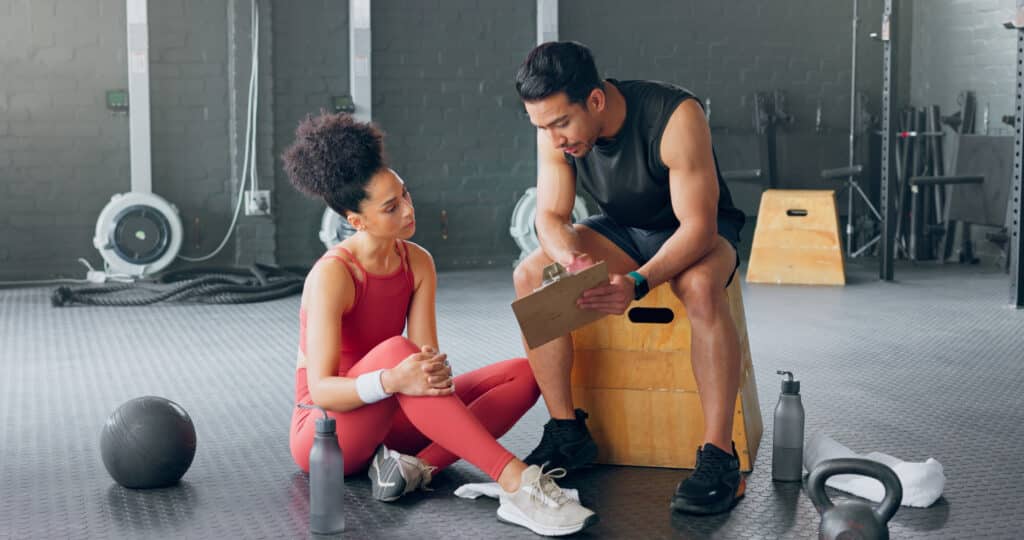
That’s not to say there aren’t men that can benefit from programming curtsy lunges into their routine. Anyone can! Personal trainers can take an objective look at muscle imbalances of the lower body by either performing an overhead squat assessment or looking at static posture and bone structure. Then, you could determine if using the curtsy lunge to strengthen that particular musculature is an ideal approach.
How to execute a curtsy lunge
Start this exercise with bodyweight only and work towards a high rep range. If the client has weak abductors they will need to build up muscular endurance before working on strength. In fact, starting with a hip activation exercise is wise in this scenario.
- Stand with legs hip width apart.
- Step back with the right leg, crossing behind the left far enough to allow the back knee to bend freely down. (Clients tend to reach back too far; aim for approximately 18 inches diagonally from the front heel.
- The back heel remains in the air (toes flexed) while the knee drops down to the floor.
- The front knee follows, bending in the same direction as the toes beneath it.
- Torso remains upright throught and glutes engaged.
- Push through the front heel and ball of the foot to return to start.
Who benefits most?
Anyone with weak abductors and/or adductors will work these smaller muscle groups through a greater range of motion than any other compound lower body movement. Women with wide hips (aghem, raises hand….) in particular will find this movement challenging and will see the greatest results.
What does the curtsy lunge emphasize that other lunges don’t?
By crossing one leg behind the other, both hips are now in adduction and slight external rotation. This places the hip abductors such as gluteus medius, gluteus minimus and TFL in a lengthened position at the bottom of the movement before the concentric phase begins. This added tension to weak muscles in their weakest position will demand more of them, working through a full range of motion when rarely are they required to do so.
In addition, the ” squeeze” at the bottom of the movement that occurs by way of contraction of the adductors engages them more deeply at their end range than any other movement. If someone has overactive abductors and underactive adductors could perform the movement in a stationary position (i.e., don’t return to start, but keep feet planted while lunging); this will fire up the adductors while giving the abductors a loaded stretch.
Advancements
-
- Add a leg lift (hip abduction) of the back leg as it returns to the start position instead of bringing it back to start.
- Add a squat at the start position
- Add weight, starting with one hand, then both.
- Step on to a bench or box. Remember to descend slowly and with control.