
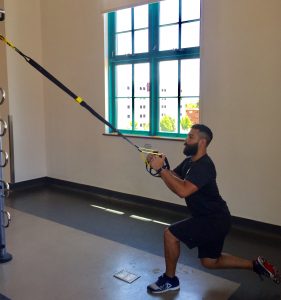
What can you do to up the ante once clients have become comfortable with their beginner suspension strap lunge? Of course, you could simply remove the straps and have clients continue to work on static lunges without any equipment, but it is nice to spice things up a bit while also giving clients a progression with the tools they’ve already become comfortable using.
Before integrating the suspension training system with lunges, it may be helpful to start with squats using the straps. This will allow the client to slowly build their range of motion (ROM) while getting comfortable with the equipment. Next, the beginners lunge using the suspension straps can be introduced.
Take a Step Back to Step Forward
While it is important to modify movements for clients with limitations, it is equally as important to continue to challenge clients by building on their ROM, and endurance (muscular or cardiovascular). Over time, clients will begin to discover that the lunge modification has served its purpose, and they are ready to go a little further. They may still need to stay within the realm regression, but taking the next indicated step toward progression presents itself sooner or later.
How to do Intermediate Suspension Strap Lunges Step by Step
- Center the front leg as they face the anchor point.
- Stack their elbows under their shoulders without any slack in the straps.
- Lift the back leg bringing it in front of them to a 90-degree angle while still balancing on the front leg.
- Then, lower the front leg, and send the back leg back.
- They can touch the ball of the foot down for more stability, or float their back foot without touching to advance the movement.
- Weight in the heel and chest lifted to come back up.
[info type=”facebook”]Share your favorite intermediate lunge move with other trainers on the NFPT Community Page. If you’re not NFPT Certified, come chat with NFPT here – we’d love to meet you![/info]