

Performing bodyweight dips requires mastering your entire bodyweight just like its distant cousins the chin-up and the pull-up. Dips also require extensive shoulder mobility to perform effectively and without injury–probably even more so that the two former.
The dip hits heavily the pectorals, anterior deltoids and triceps muscles. Secondarily, the lats are employed at the end range as the shoulder extends back to start, the rhomboids squeeze the shoulder blades together, the rotator cuff complex works to stabilize the shoulder joint and the lower traps work to control scapular downward rotation.
Potential Limitations to Performing Dips
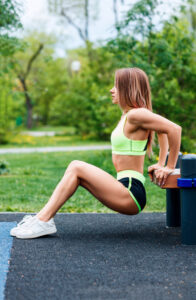
Strength imbalances will make unassisted dips impossible to execute, so beginning with assistance and watching form is a good idea before progressing to body weight. Furthermore, proper mobility is key for proper execution of a dip. The most obvious area of restriction is in shoulder extension. A tight anterior deltoid will certainly prevent a full range of motion in this exercise.
To determine shoulder readiness, test end range shoulder extension by having the client perform a triceps bench dip. At the bottom of this motion, the shoulders should not excessively elevate, the upper arm should come close to parallel to the floor, and the elbows should not flare out more than a few degrees.
Shoulder Prep for Dips
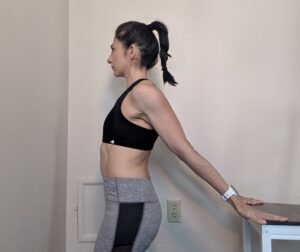
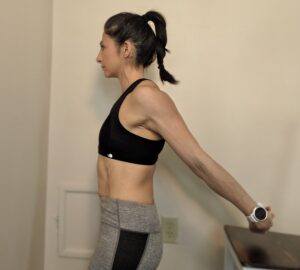
The dip can be stressful on the shoulder so be sure to properly warm up the joint with some basic mobility exercises first. If anterior deltoid mobility is limited work on improving this range of motion by performing end-range activation. You can use a chair while kneeling on the floor as below, a bar-height table at home, or a racked barbell. You want a stable surface in any case.
Executing Dips
- Approach parallel bars set to shoulder height, but use a step to get high enough to grasp both bars without jumping
- Try to keep wrists as straight as possible and knuckles facing the floor
- Keep eyes cast on the floor about 10 feet ahead and cervical spine straight
- Keep legs straight and together and ankles uncrossed to activate core muscles
- Push up by extending the elbows straight but do not totally lock out into hyperextension (maintain muscle tension and do not rely on the joints to hold this top position
- Inhale while descending, engaging the core, bending the elbows and squeezing the shoulder blades together and down to keep the elbows from flaring and the shoulders from elevating too much
- The legs can either float straight back with an increased forward angle to emphasize deltoids
OR
- The hips may flex with knees extended into a pike position which will place more tension on triceps
- Exhale to push back up
Progressing a Bodyweight Dip
When a client has progressed far enough to perform 15 bodyweight dips with ease, adding weight to the well-executed dip is appropriate. This can be accomplished by wearing a weight belt (dip belt) with a chain that can be threaded through weight plates.
Alternatively, a nimble individual can grasp a dumbbell between both feet, which contributes the added challenge of controlling the lower body with optimal core activation.