

The oblique abdominal muscles have an interesting relationship with one another. Most personal training clients know that doing diagonal or crossover crunches exercise the obliques. Exploring the obliques beyond basic location and mainstream function helps personal training clients avoid injuries and dysfunction in the core muscle region.
Feeling each muscle contract on yourself enhances body awareness and the mind-body connection. You can then guide clients to become more in tune with their muscles. Let’s explore!
External Oblique (EO) Location
Use the directions to find the attachment points on yourself and connect to where external oblique attaches. Try laying supine on a table or mat and initiate a diagonal crunch while you palpate the origin and insertion of the muscle.

Origin: External surfaces of ribs 5-12
- Place hands on sides of rib cage with small finger aligned with the last rib (12)
- Sidebend to feel the EO contract in between the ribs
Insertion: Anterior iliac crest, abdominal aponeurosis to linea alba
- Identify rectus abdominis (RA) to feel where EO meets RA
- Locate the superior (top) ridge of the iliac crest (hip bone)
- The linea alba connects from the sternum down to the pubic bone, splitting the RA and obliques into right and left sides
Internal Oblique (IO) Location
Use these directions to find the attachment points on yourself and connect to where external oblique attaches. Lay supine on a table or mat and initiate what would be a diagonal crunch while you palpate the origin and insertion of the muscle.
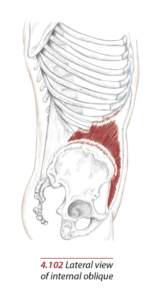
Origin: Lateral inguinal ligament, iliac crest, and thoracolumbar fascia
- Locate the anterior superior iliac spine (ASIS) – the inguinal ligament attaches from this point to the pubic bone – which is also where the hip bones meet
- Locate the superior (top) ridge of the iliac crest (hip bone)
- The thoracolumbar fascia attaches into the lumbar vertebrae, it is a thick band of connective tissue on the posterior inferior back – the latissimus dorsi muscle anchors into this fascia
Insertion: Internal surface of ribs 9-12, abdominal aponeurosis to linea alba
- Curl fingers around anterior (front) inferior (lower) ribs
- Identify rectus abdominis (RA) to find the abdominal aponeurosis
- The linea alba connects from the sternum down to the pubic bone, splitting the RA and obliques into right and left sides
External and Internal Oblique Action
- Flex the spine
- Laterally side bend the spine
- Rotate the spine
The direction of rotation of the spine can be explored via biomechanics. External oblique is an opposite side rotation muscle, while internal oblique is a same side rotation muscle. They work together.
- Right external oblique and left internal oblique rotate the spine LEFT.
- Left external oblique and right internal oblique rotate the spine RIGHT.
To explore the actions, place your hands on your lateral ribs and rotate while you visualize the muscles working together.
- If you flex, rotate left and side bend the spine slightly the left internal oblique will shorten completely.
- If you flex, rotate right and side bend the spine slightly the right internal oblique will shorten completely.
- To shorten right external oblique completely, rotate to the left, side bend to the right, and flex the spine.
- To shorten left external oblique completely, rotate to the right, side bend to the left, and flex the spine.
It can take time to fully wrap your brain around the mechanics of the obliques, just keep practicing and try teaching it to someone else.
Exercises for External and Internal Obliques
Working the obliques as a core unit can be quite simple. Any exercise that calls upon one of the actions mentioned above will recruit the obliques. If you do an exercise combining all three actions it maximizes the potential for each muscle to contract.
Here are some exercises that are commonly performed to exercise the obliques.
- Crunches with rotation
- Resistance band rotation – oblique twist
- Stability Ball Crunches
- Plank – forearms or hands
- Side Plank
Stretch External and Internal Obliques
To stretch the external and internal obliques, perform the opposite movements of the actions. If stretches cause too much discomfort, do one reverse action at a time. For maximal stretch perform all of the antagonistic motions together. If there is pain when stretching – for you or personal training clients, consult with a physician.
Antagonistic (opposite) actions for stretching
- Extend the spine
- Laterally side bend the spine to the opposite side you want to stretch
- Rotate the spine (in accordance with which oblique and which side you want to stretch)
In general, side bending to the right will stretch the left obliques and side bending to the left with stretch the right obliques. Extension will also stretch all obliques. Adding rotation will intensify the stretch depending on which side.
Try these stretches
- Cobra pose – laying supine, arch the spine up slowly and gently until a stretch is felt
- Side bend – while standing or kneeling, slide one hand down the same side thigh to stretch, try not to collapse, bend like a flower stem – gently
- Seated Twist – sit on the floor and slowly twist the entire spine as far as is comfortable
The external and internal obliques are popular and important muscles to train. Identifying the attachments of origin and insertion and understanding their relationship to each other enhances body awareness, which can increase performance and decrease the risk of injury.
INCREASE YOUR KNOWLEDGE. INCREASE YOUR CONFIDENCE. TAKE THE ANATOMY COURSE.
References
Abrahams, P.H. et al. 2003. McMinn’s Color Atlas of Human Anatomy. London: Elseiver.
Biel, Andrew. 2014. Trail Guide to the Body 5th edition. Boulder: Books of Discovery.
Muscolino, Joseph E. 2004. Musculoskeletal Anatomy Coloring Book. Philadelphia, PA: Mosby, Inc.